

what is permaculture?
“Permaculture” was first coined in the 1970’s. In essence, permaculture is a design method and set of strategies based on ecological principles, patterns, and systems thinking. It draws wisdom from indigenous cultures and encompasses land use, food, water, energy, shelter, social and economic systems.
Permaculture helps us shift to an ecological lens which can be applied to every aspect of our lives. We learn to look at a situation or problem not in isolation, but as part of a larger, interconnected system of relationships, environments, and influences. Permaculture design works with nature; using it as a teacher and guide.
By slowing down and observing nature, we can design integrated backyard ecosystems that:
Require less labor (after establishment), fertilizer, imported soil, and imported materials
Produce more food, fiber, fuel, medicine, & fodder, which can be shared or bartered with friends and neighbors
Regenerate the land by planting perennials in layers and including species that add nutrients to the soil and surrounding plants
Help us become active producers of food and medicine for our families, while simultaneously boosting biodiversity & supporting wildlife
Become more resilient in the face of climate-related events and changes, social, and economical challenges


services
Consultations: We offer whole site consultations. We observe your land through an ecological lens, assess the property as a whole and make initial observations and recommendations based on your goals, the site conditions, and permaculture principles. The consultation results in a list of recommendations and suggested plants. The length of the consultation depends on the size and complexity of the site.
Design: If after having a consultation you would like a fully drawn property plan we will credit the cost of the consultation towards the design. We will collaborate on a vision statement, design elements, and suggested plant lists. You will receive a plan view color design, plant list, and suggested phasing and installation recommendations.
Implementation: We can recommend installers who use permaculture principles and methods to implement your design. We can also serve as consultants if you would like to learn how to implement your design yourself.
Coaching: We offer one-on-one coaching that can range from a single afternoon of working side-by-side to a series of custom educational modules. This could include:
Fundamentals of design including site analysis - observing your property as a whole vs component parts
New garden beds - learn how to build nutrient-dense soil from the ground up. Do you have a space dedicated for a new garden? We can work alongside you to prepare your new garden bed.
Fruit tree planting - preparation and polyculture planning. A polyculture is a grouping of plant species that work together, often occupy different root zones and offer different benefits to the fruit tree and surrounding plants. A polyculture mimics the diversity of a natural ecosystem.
Designing a food forest - learn how to plan a multi-layered, edible ecosystem.
For more information, contact Julie at julie@larkspurdesign.me
CASE STUDY: Applied permaculture principles at a home in Falmouth
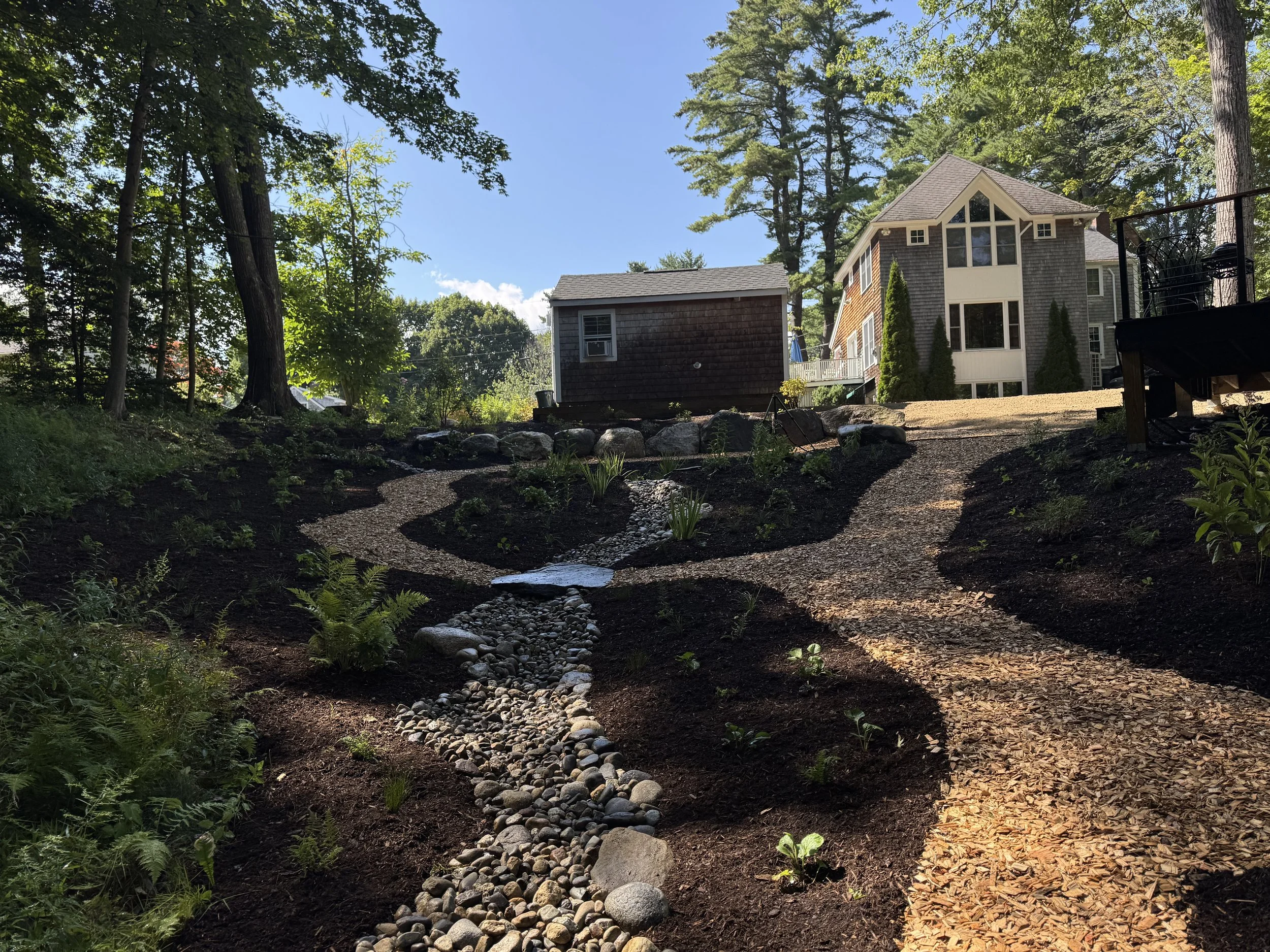
We spent several seasons observing a site in Falmouth and designing a space for multiple uses and users (homeowners, renters, and wildlife). The site slopes from the road down to the back of the site which abuts Casco Bay. A large amount of water flowed through the site, eroding and depleting soils. We wanted to slow the water down and minimize sediment and road salts that were making their way to the bay. We also wanted water coming into the site to be utilized by new plantings of trees, shrubs, and groundcovers. Several swales were built as well as a rain garden to slow, sink, and store water in the landscape.
Two important principles:
Observe and interact. By taking time to observe a site over time we are informed by natural patterns to apply solutions that work with the site.
Catch and store energy. This principle guides us to collect energy or resources when they are abundant, storing them for use in times of need.